A remote Swiss valley models global climate

New article!

Using data from the unspoiled Swiss Val Ferret region, EPFL statisticians have used extreme value theory to develop a way to model extreme rainfall across the world.

I like the Val Ferret. If Switzerland ever makes its own version of “An American werewolf in London”, that’s where they’ll film it.

Taste that sweet sweet science here.

— Nik (in Athens GR at the moment)
Sniffing out fake perfumes

New article!

Using a new method of ionisation, researchers from EPFL have found a quick way to identify counterfeit perfumes. The hope is to extend the method, called ESTASI,  to other chemicals too.

You can read more here. It smells nice.

–Nik

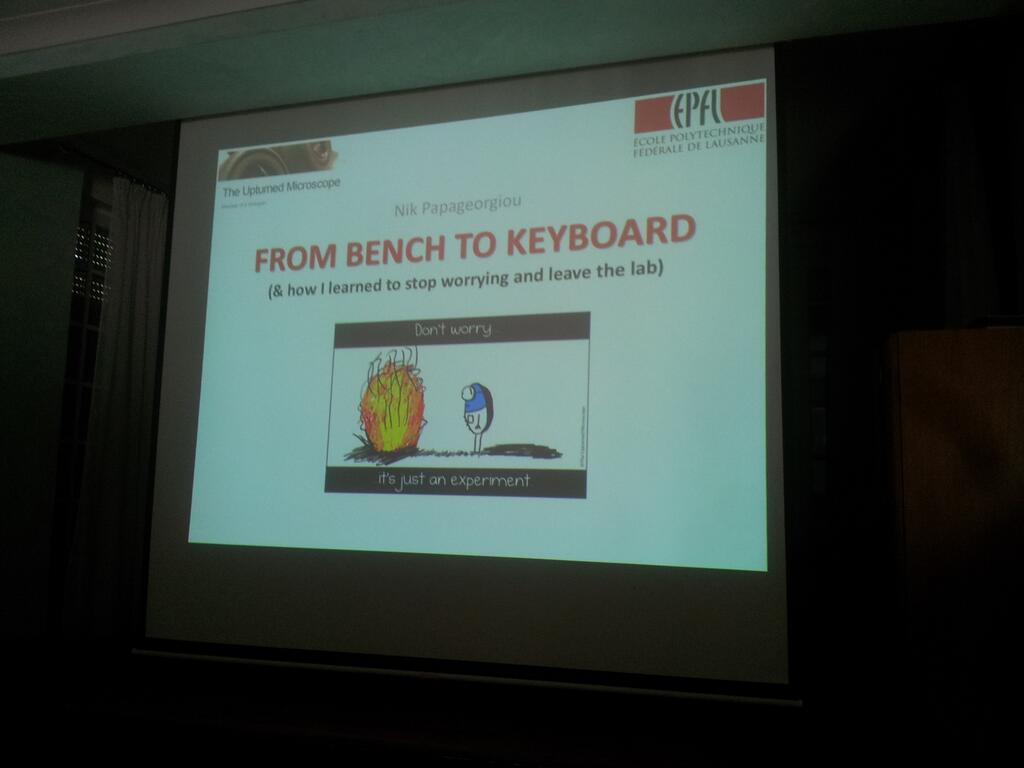
MFPL retreat: From bench to keyboard

A photo of my opening slide by organiser Stephanie Bannister (@S_Bann).

Last week I was invited to speak about science communication at the MFPL retreat at Znojmo (CR). It was great to meet fans of the blog and chat with PhDs and postdocs about comics, cell/molecular biology (the MFPL does some really cool stuff), lab life and science careers.  Once again, I was struck by how rife with problems academic research is, and I hope that this little talk might spark some non-traditional, yet much-needed career paths.

Click here if you’d like to check out my 11-slide PowerPoint.

Shedding light on photosynthesis

New article on EPFL with a totally original title – I dare you to Google it to see how unique it is.

Using Atomic Force Microscopy to figure out what the thylakoid membrane does during photosynthesis (it’s an interesting paper too, read it if you can get  hold of it). Everything makes sense when you can see it. That’s my cell biologist motto.

Read it here.

Bacterial spears and spear-tips

Published today in Nature, one of the weirdest organelles ever found in a cell: The type VI secretion system. It looks like a retractable spear. I kid you not – a spear. With a poisoned tip, to literally stab and kill other cells.

Here’s my article covering the research. Why don’t you take a STAB at it? Yeah. Scientific writing is all about the puns.

— Nik